Epitalon
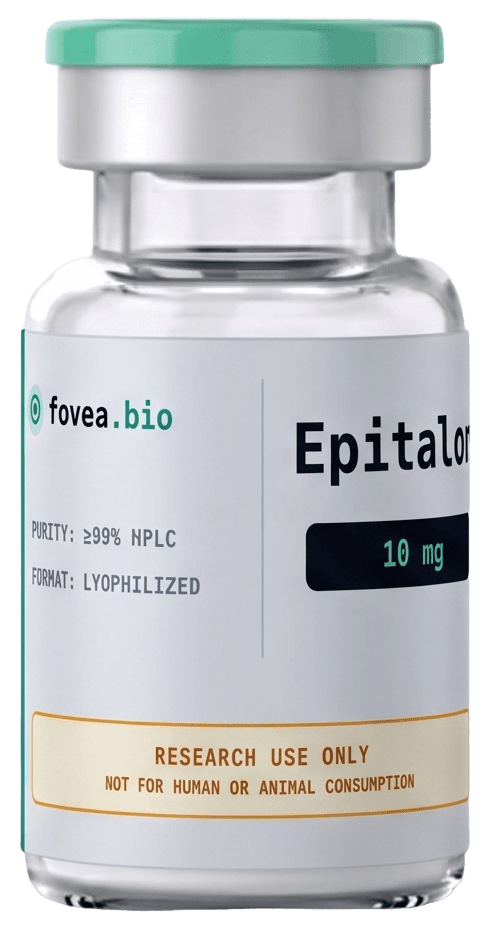
Epitalon (Ala-Glu-Asp-Gly, AEDG)
- ≥99% HPLC
- LC-MS Verified
- Tested
- Vacuum-Sealed
- Cold-Chain Ready
A four-amino-acid peptide best known for switching on telomerase, with a long research history in retinal-degeneration models. It is utilized in aging studies to explore telomere elongation, genomic protection, and the delay of cellular senescence.
4 residues · teal = non-canonical / D-isomer · descriptive schematic
Relevance to Vision Research
Epitalon is one of the most-studied short peptides in the retinal-longevity literature, where interest centers on telomerase regulation in retinal cells and on observations in inherited retinal degeneration.
Where It Acts : Pathway Map
7 structures targetedAn animated map of the visual pathway, from the eye through the brain to the systemic processes of aging. Highlighted nodes mark the structures Epitalon is studied against.
Illustrative research map : highlighted structures reflect the published in-vitro / preclinical literature, not human outcomes.
Key Performance Benefits
Scientifically supported advantages for peak performance and recovery.
Cellular Longevity & Anti-Aging
Activates telomerase (hTERT) to protect DNA and extend the healthy lifespan of cells, combating the root causes of aging at the molecular level.
Restores Circadian Rhythm
Optimizes the pineal gland to naturally regulate melatonin production, ensuring deep, restorative sleep essential for peak physical and mental recovery.
Accelerates Tissue Recovery
Enhances the body's natural antioxidant defenses to rapidly clear oxidative stress and accelerate recovery after intense exertion.
Disclaimer: Epitalon should be used responsibly. These statements have not been evaluated by the FDA. Not intended to diagnose, treat, cure, or prevent any disease.
What the Research Shows
3 references ↓Studied in retinal degeneration[1]
Examined in animal models of retinitis pigmentosa and age-related retinal dystrophy.
Visual efficiency[1]
Researched for maintaining functional sensitivity and structural integrity of retinal photoreceptors.
Retinal protection[1]
Studied for preventing cell death in retinal pigment epithelium (RPE) cells under oxidative stress.
Activates telomerase[2]
Reported to switch on telomerase (hTERT) and lengthen telomeres in human cells.
Lifespan research[2]
Investigated in rodent aging and tumor-incidence studies in the gerontology literature.
Pineal–circadian axis[1]
Linked to the melatonin axis that intersects with retinal and circadian physiology.
Antioxidant support[2]
Reported to support antioxidant enzyme systems in aging-model studies.
Immune & thymus research[3]
Studied for effects on thymic function and immune resilience in aging-model studies.
Melatonin-rhythm studies[3]
Examined for effects on melatonin secretion and circadian rhythm in animal models.
Summaries of observations reported in published in-vitro and preclinical research. These are research-model findings, not established human outcomes, and not claims of benefit, safety, or efficacy. Supplied for laboratory research use only.
Literature Protocol Reference
Preclinical and clinical trial parameters documented in published literature. Reconstituted reference materials are designed for laboratory analysis and in-vitro assays.
Research Literature Notes
Khavinson literature references: standard course of 5 mg daily for 10 days (requires 5 flacons of 10mg if splitting/combining, or 1 flacon if 1 mg/day for 10 days). Intensive courses evaluate 10 mg daily for 10 days (split into 5 mg morning and 5 mg evening). Can be mixed with Pinealon in the same syringe.
Why It Is Used
AEDG is a compact, highly acidic tetrapeptide (two carboxylate side chains across four residues), giving it a strong negative charge and high water solubility. In the in-house flexible docking, that acidic, mobile backbone is consistent with shallow groove-level contacts against the hTERT promoter duplex rather than deep intercalation. As a research standard it is small, soluble, and unambiguous by MS.
Objective structural / physicochemical opinion. Not medical advice.
Related Scientific Reports
Read the full literature review on EpitalonEpitalon and Retinal Longevity: Telomerase Regulation in Retinal Degeneration Models
A review of the Khavinson short-peptide literature on AEDG (Epitalon), focused on reported telomerase (hTERT) induction and on retinoprotective observations in models of inherited retinal degeneration such as retinitis pigmentosa. The systemic gerontology literature is summarized secondarily. Reference survey only; no human outcome is asserted.
In-Silico Peptide:DNA Topology: AEDG Conformation in the hTERT Promoter Groove
An all-atom flexible-docking study of the tetrapeptide AEDG (Epitalon) against a model of the hTERT proximal promoter duplex. Conformer ensembles were generated and ranked by interface contact density and predicted binding free energy. Reported as structural reference data characterizing candidate groove geometries; no functional or transcriptional outcome is asserted.
Documented References
- [1]
Khavinson VK, Razumovsky M, et al. (2002) Retinoprotective effect of the peptide Epitalon in models of hereditary retinal degeneration.
Neuroendocrinology Letters (Khavinson peptide series)
View on PubMed - [2]
Khavinson VK, et al. (2003) Epithalon peptide induces telomerase activity and telomere elongation in human somatic cells.
Bulletin of Experimental Biology and Medicine
View on PubMed - [3]
Anisimov VN, Khavinson VK, et al. (2003) Effect of Epitalon / epithalamin on melatonin, immune (thymic) function, and lifespan in animal models.
Mechanisms of Ageing and Development (and related work)
View on PubMed
References point to published, third-party scientific literature, provided for research context. Citation of a study is not an endorsement of any use of this material.
Molecular Identity
- CAS Number
- 307297-39-8
- Molecular Formula
- C₁₄H₂₂N₄O₉
- Molecular Weight
- 390.35 g/mol
- Sequence
- H-Ala-Glu-Asp-Gly-OH (AEDG)
- Purity
- ≥ 99.0% (HPLC, area)
- Format
- Lyophilized powder, vacuum-sealed vial
Analytical Specification
Research Context
Epitalon (AEDG) is a synthetic tetrapeptide derived from the pineal peptide preparation epithalamin. The published literature reports in-vitro and model-organism studies of its proposed interaction with chromatin and telomerase (hTERT) transcriptional regulation. Catalogued here as a sequence-defined peptide reference standard for nucleic-acid interaction and chromatin assays.
Active in-silico track: flexible peptide–dsDNA docking of AEDG against the hTERT promoter region using all-atom predictors. Conformer ensembles and contact maps published, anonymized, in the Analytics Hub as structural reference data only.
Laboratory Handling
Soluble in laboratory-grade water. Bacteriostatic-water solubility data provided for in-vitro handling only.