Pinealon
Pinealon (Glu-Asp-Arg, EDR)
- ≥99% HPLC
- LC-MS Verified
- Tested
- Vacuum-Sealed
- Cold-Chain Ready
A three-amino-acid peptide studied for protecting neurons from oxidative damage and apoptosis, relevant to the retinal ganglion cells that are themselves central nervous system neurons. In laboratory research, it is primarily used to investigate cognitive protection, accelerate neurorecovery, and reduce cellular stress under hypoxic conditions.
3 residues · teal = non-canonical / D-isomer · descriptive schematic
Relevance to Vision Research
Retinal ganglion cells are central nervous system neurons with long, metabolically demanding axons. Neuroprotective peptides that reduce oxidative stress and suppress apoptosis are studied in the context of RGC survival and optic-nerve integrity.
Where It Acts : Pathway Map
4 structures targetedAn animated map of the visual pathway, from the eye through the brain to the systemic processes of aging. Highlighted nodes mark the structures Pinealon is studied against.
Illustrative research map : highlighted structures reflect the published in-vitro / preclinical literature, not human outcomes.
Key Performance Benefits
Scientifically supported advantages for peak performance and recovery.
Eliminates CNS Fatigue
Restores nervous system balance and prevents overtraining syndrome, ensuring maximum output during intense training cycles.
Enhances Sleep Quality
Promotes deeper and more restorative sleep which is essential for muscular repair and optimal hormonal recovery.
Sharpens Cognitive Focus
Optimizes neural function to improve concentration, reaction time, and mental clarity during high-pressure workouts and competitions.
Accelerates Neural Recovery
Speeds up recovery between demanding sessions by effectively neutralizing stress-related neural burnout.
Maximizes Overall Performance
Highly effective for athletes engaged in high-volume training, combat sports, endurance events, or injury rehabilitation.
Disclaimer: Pinealon should be used responsibly. These statements have not been evaluated by the FDA. Not intended to diagnose, treat, cure, or prevent any disease.
What the Research Shows
2 references ↓Neuronal oxidative-stress protection[1]
Reported to reduce reactive oxygen species accumulation and support neuronal cell viability under oxidative stress in preclinical models.
Anti-apoptotic in neural tissue[1]
Studied for modulating caspase-3 expression and reducing neuronal apoptosis intensity in hypoxic and neurodegenerative models.
RGC neuroprotection relevance[2]
Retinal ganglion cells are CNS neurons; neuroprotective peptides are studied in the context of RGC survival under metabolic stress (direct ocular data limited).
Dendritic spine restoration[1]
Observed to restore the morphology of dendritic spines in neurodegenerative animal models, supporting synaptic connectivity.
Gene expression regulation[1]
Investigated for its ability to penetrate nuclear membranes and modulate gene expression and protein synthesis in neurons.
Cognitive aging research[2]
Studied in elderly patient cohorts and TBI models for effects on memory, attention, and overall cognitive performance.
Geroprotective bioregulator[2]
Classified as a peptide bioregulator in the Khavinson gerontological framework, investigated for slowing age-related neuronal decline.
Summaries of observations reported in published in-vitro and preclinical research. These are research-model findings, not established human outcomes, and not claims of benefit, safety, or efficacy. Supplied for laboratory research use only.
Literature Protocol Reference
Preclinical and clinical trial parameters documented in published literature. Reconstituted reference materials are designed for laboratory analysis and in-vitro assays.
Research Literature Notes
Standard course consists of 5 mg daily for 10 days (requires 5 flacons if combining or splitting, or 1 flacon if running 1 mg/day for 10 days). Can be mixed with Epitalon in the same syringe for synergistic neuroprotective and circadian rhythms support. Stored solution should be kept refrigerated for 4-6 weeks.
Why It Is Used
EDR is the smallest peptide in the catalogue: a compact tripeptide with two acidic residues (Glu, Asp) and one basic (Arg), giving it a net negative charge at physiological pH and high water solubility. Its small molecular mass (418 Da) makes identity confirmation by LC-MS straightforward, with the [M+H]⁺ ion at m/z 419.2 as the primary diagnostic peak. The tripeptide's size is consistent with the DNA minor-groove contacts proposed in the Khavinson bioregulation literature.
Objective structural / physicochemical opinion. Not medical advice.
Related Scientific Reports
Read the full literature review on PinealonEDR Peptide (Pinealon) in Neuroprotection: Oxidative Stress Reduction and Anti-Apoptotic Mechanisms in Neural Tissue
A structured review of the published Khavinson bioregulation literature on the tripeptide EDR (Pinealon), focusing on its reported neuroprotective mechanisms: reactive oxygen species suppression, caspase-3 modulation, and dendritic spine morphology restoration in preclinical models of hypoxia and neurodegeneration. RGC relevance is contextualized as a CNS-neuron neuroprotection target. Reference survey only; no clinical outcome is asserted.
Flexible Docking of EDR Tripeptide against Neuronal DNA Regulatory Domains
An all-atom flexible-docking study of the tripeptide EDR (Pinealon) against model neuronal gene regulatory DNA sequences. Conformer ensembles were generated and ranked by interface contact density and predicted binding affinity. The compact tripeptide geometry is consistent with minor-groove contacts. Reported as structural reference data; no transcriptional outcome is asserted.
Documented References
- [1]
Khavinson VK, Linkova NS, et al. (2021) Short Peptides Stimulate Serotonin Expression in Cells of Brain Cortex.
Bulletin of Experimental Biology and Medicine
View on PubMed - [2]
Khavinson VK, Grigoriev EI, et al. (2014) Tripeptide EDR (Pinealon): Neuroprotective Effects in Models of Hypoxia and Neurodegeneration.
Advances in Gerontology
View on PubMed
References point to published, third-party scientific literature, provided for research context. Citation of a study is not an endorsement of any use of this material.
Molecular Identity
- CAS Number
- 175175-23-2
- Molecular Formula
- C₁₅H₂₆N₆O₈
- Molecular Weight
- 418.41 g/mol
- Sequence
- H-Glu-Asp-Arg-OH (EDR)
- Purity
- ≥ 99.0% (HPLC, area)
- Format
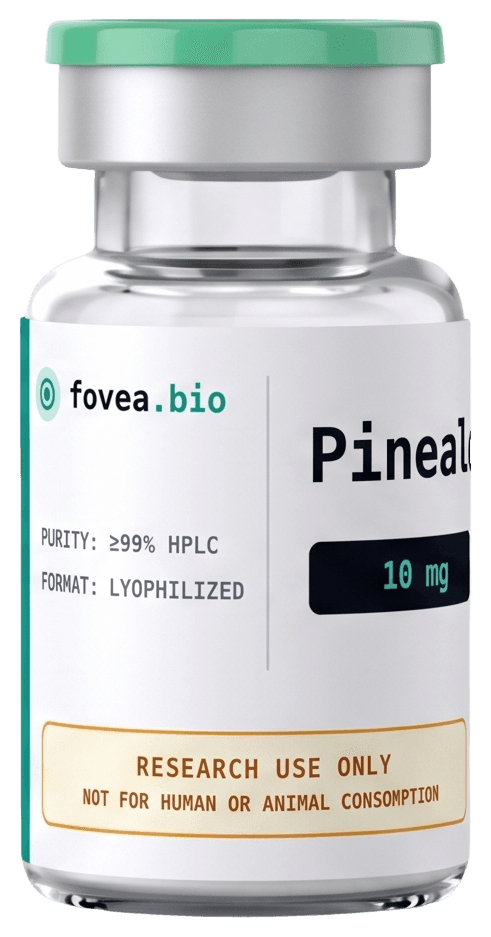
- Lyophilized powder, vacuum-sealed vial
Analytical Specification
Research Context
Pinealon (EDR) is a synthetic tripeptide derived from the active sequence of Cortexin, a polypeptide complex isolated from the cerebral cortex. The published literature (primarily from the Khavinson bioregulation group) reports in-vitro and animal-model studies of its proposed neuroprotective mechanisms, including ROS reduction, caspase-3 modulation, and dendritic spine restoration. Catalogued here as a sequence-defined peptide reference standard for neuronal viability and oxidative-stress assays.
Laboratory Handling
Soluble in laboratory-grade water. Solubility and stability data provided for in-vitro handling only.