Epitalon
Epitalon (Ala-Glu-Asp-Gly, AEDG)
- ≥99% HPLC
- LC-MS Verified
- Tested
- Vacuum-Sealed
- Cold-Chain Ready
A four-amino-acid peptide best known for its reported effect on telomerase, with a long research history in retinal-degeneration models. It is used in aging studies to probe telomere length, genomic stability, and the onset of cellular senescence.
4 residues · teal = non-canonical / D-isomer · descriptive schematic
Relevance to Vision Research
Epitalon is one of the most-studied short peptides in the retinal-longevity literature, where interest centers on telomerase regulation in retinal cells and on observations in inherited retinal degeneration.
Where It Acts : Pathway Map
7 structures targetedAn animated map of the visual pathway, from the eye through the brain to the systemic processes of aging. Highlighted nodes mark the structures Epitalon is studied against.
Illustrative research map : highlighted structures reflect the published in-vitro / preclinical literature, not human outcomes.
Key Performance Benefits
Scientifically supported advantages for peak performance and recovery.
Telomerase and hTERT regulation
In-vitro studies in cultured human somatic cells report increased telomerase activity and hTERT expression. Cell-culture findings only.
Pineal and circadian literature
The Khavinson bioregulation literature reports effects on melatonin rhythm in animal models. Independent replication outside that research tradition is limited.
Retinal degeneration models
Model-organism work in inherited retinal degeneration reports preserved photoreceptor structure. No human outcome is established.
Research use only. Not a drug, food, cosmetic, or supplement. Not for human or veterinary use, consumption, or administration by any route. Not evaluated by the FDA. Nothing on this page is intended to diagnose, treat, cure, or prevent any disease, and no human outcome is asserted.
Reported in the literature
3 references ↓Studied in retinal degeneration[1]
Examined in animal models of retinitis pigmentosa and age-related retinal dystrophy.
Visual efficiency[1]
Researched for maintaining functional sensitivity and structural integrity of retinal photoreceptors.
Retinal protection[1]
Studied for preventing cell death in retinal pigment epithelium (RPE) cells under oxidative stress.
Activates telomerase[2]
Reported to switch on telomerase (hTERT) and lengthen telomeres in human cells.
Lifespan research[2]
Investigated in rodent aging and tumor-incidence studies in the gerontology literature.
Pineal–circadian axis[1]
Linked to the melatonin axis that intersects with retinal and circadian physiology.
Antioxidant support[2]
Reported to support antioxidant enzyme systems in aging-model studies.
Immune & thymus research[3]
Studied for effects on thymic function and immune resilience in aging-model studies.
Melatonin-rhythm studies[3]
Examined for effects on melatonin secretion and circadian rhythm in animal models.
Summaries of observations reported in published in-vitro and preclinical research. These are research-model findings, not established human outcomes, and not claims of benefit, safety, or efficacy. Supplied for laboratory research use only.
Where Epitalon came from
Epitalon is the synthetic short form of something older. In the Soviet-era work of Vladimir Khavinson and colleagues, an extract of pineal tissue called epithalamin was studied for effects on aging in model organisms. Epitalon is the four-residue sequence, Ala-Glu-Asp-Gly, that the group proposed as the active core of that preparation.
Four residues is very short. That matters for how the proposed mechanism reads: rather than a receptor-binding ligand, the Khavinson literature describes these peptides as interacting directly with DNA and chromatin, with sequence-specific contacts in promoter regions. Whether that model is correct remains contested outside the group that proposed it, and a reader should hold it loosely.
The telomerase question
The claim that draws most attention is the reported induction of telomerase, specifically transcriptional regulation at the hTERT promoter. Published in-vitro work reports increased telomerase activity in cultured human somatic cells, and a portion of the retinal interest follows from studies in models of inherited retinal degeneration.
Two things are worth separating here. Telomerase induction in a cell culture is a measurable, reproducible-in-principle observation. Extrapolating from that to anything about aging in a person is a leap the data does not support, and the published work is heavily concentrated in a small number of affiliated groups, which is a limitation rather than a conspiracy.
The structural side of the question, how a four-residue peptide could adopt a defined conformation inside the hTERT promoter groove at all, is the subject of our in-silico topology note. The retinal literature is surveyed here.
What this vial is for
Catalogued as a sequence-defined peptide reference standard for nucleic-acid interaction and chromatin work: electrophoretic mobility shift assays, promoter-binding studies, telomerase activity assays in cultured cells, and structural or docking work requiring a characterised AEDG standard.
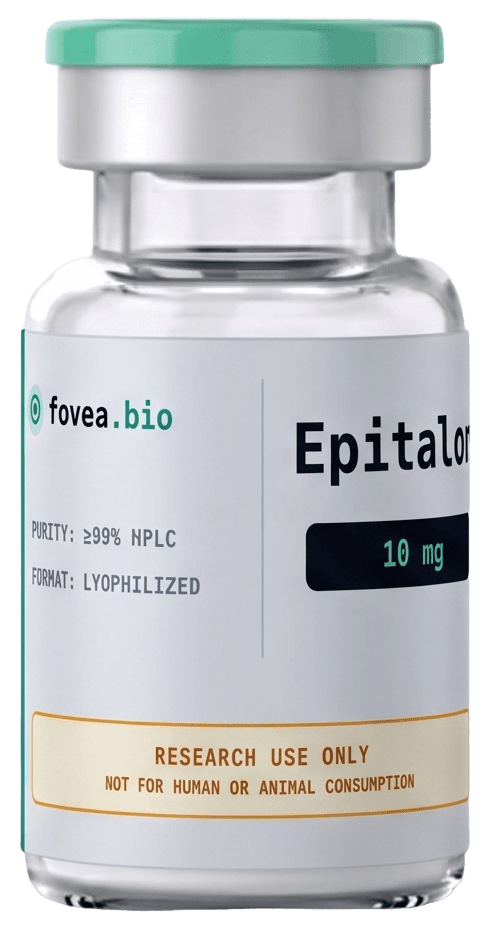
Short, highly polar peptides like AEDG are easy to synthesise and correspondingly easy to supply at variable quality. Identity is confirmed by LC-MS and purity by HPLC to a ≥99% specification.
Epitalon: common questions
- What is Epitalon?
- Epitalon is a synthetic tetrapeptide with the sequence Ala-Glu-Asp-Gly (AEDG), also written as epithalon. It was derived from epithalamin, a pineal peptide preparation studied by the Khavinson group, and is used in research as a sequence-defined standard for chromatin and telomerase work.
- Is Epitalon the same as epithalamin?
- No. Epithalamin is a peptide preparation extracted from pineal tissue and is a mixture. Epitalon is a single defined four-residue synthetic peptide proposed as the active core sequence of that preparation.
- What does the telomerase research actually show?
- Published in-vitro studies report increased telomerase activity and hTERT expression in cultured human somatic cells, along with model-organism work in retinal degeneration. These are cell-culture and animal-model observations. They do not establish any effect in humans, and the literature is concentrated among a small number of affiliated research groups.
- How can a four-residue peptide interact with DNA?
- That is the open question. The Khavinson model proposes sequence-specific contacts in promoter regions, with the peptide sitting in the major or minor groove. Whether a tetrapeptide can hold a defined conformation there is exactly what structural and docking work is used to probe, and it remains debated.
- How is the Epitalon reference standard supplied and stored?
- As a lyophilized powder in a vacuum-sealed amber vial. Store at −20 °C, desiccated, and avoid repeated freeze-thaw of reconstituted aliquots. Identity is confirmed by LC-MS and purity by HPLC to a ≥99% specification.
Why It Is Used
AEDG is a compact, highly acidic tetrapeptide (two carboxylate side chains across four residues), giving it a strong negative charge and high water solubility. In the in-house flexible docking, that acidic, mobile backbone is consistent with shallow groove-level contacts against the hTERT promoter duplex rather than deep intercalation. As a research standard it is small, soluble, and unambiguous by MS.
Objective structural / physicochemical opinion. Not medical advice.
Related Scientific Reports
Read the full literature review on EpitalonEpitalon and Retinal Longevity: Telomerase Regulation in Retinal Degeneration Models
A review of the Khavinson short-peptide literature on AEDG (Epitalon), focused on reported telomerase (hTERT) induction and on retinoprotective observations in models of inherited retinal degeneration such as retinitis pigmentosa. The systemic gerontology literature is summarized secondarily. Reference survey only; no human outcome is asserted.
In-Silico Peptide:DNA Topology: AEDG Conformation in the hTERT Promoter Groove
An all-atom flexible-docking study of the tetrapeptide AEDG (Epitalon) against a model of the hTERT proximal promoter duplex. Conformer ensembles were generated and ranked by interface contact density and predicted binding free energy. Reported as structural reference data characterizing candidate groove geometries; no functional or transcriptional outcome is asserted.
Documented References
- [1]
Khavinson VK, Razumovsky M, et al. (2002) Retinoprotective effect of the peptide Epitalon in models of hereditary retinal degeneration.
Neuroendocrinology Letters (Khavinson peptide series)
View on PubMed - [2]
Khavinson VK, et al. (2003) Epithalon peptide induces telomerase activity and telomere elongation in human somatic cells.
Bulletin of Experimental Biology and Medicine
View on PubMed - [3]
Anisimov VN, Khavinson VK, et al. (2003) Effect of Epitalon / epithalamin on melatonin, immune (thymic) function, and lifespan in animal models.
Mechanisms of Ageing and Development (and related work)
View on PubMed
References point to published, third-party scientific literature, provided for research context. Citation of a study is not an endorsement of any use of this material.
Molecular Identity
- CAS Number
- 307297-39-8
- Molecular Formula
- C₁₄H₂₂N₄O₉
- Molecular Weight
- 390.35 g/mol
- Sequence
- H-Ala-Glu-Asp-Gly-OH (AEDG)
- Purity
- ≥ 99.0% (HPLC, area)
- Format
- Lyophilized powder, vacuum-sealed vial
Analytical Specification
Research Context
Epitalon (AEDG) is a synthetic tetrapeptide derived from the pineal peptide preparation epithalamin. The published literature reports in-vitro and model-organism studies of its proposed interaction with chromatin and telomerase (hTERT) transcriptional regulation. Catalogued here as a sequence-defined peptide reference standard for nucleic-acid interaction and chromatin assays.
Active in-silico track: flexible peptide–dsDNA docking of AEDG against the hTERT promoter region using all-atom predictors. Conformer ensembles and contact maps published, anonymized, in the Analytics Hub as structural reference data only.
Laboratory Handling
Soluble in laboratory-grade water. Solubility data provided for in-vitro assay design and handling only.