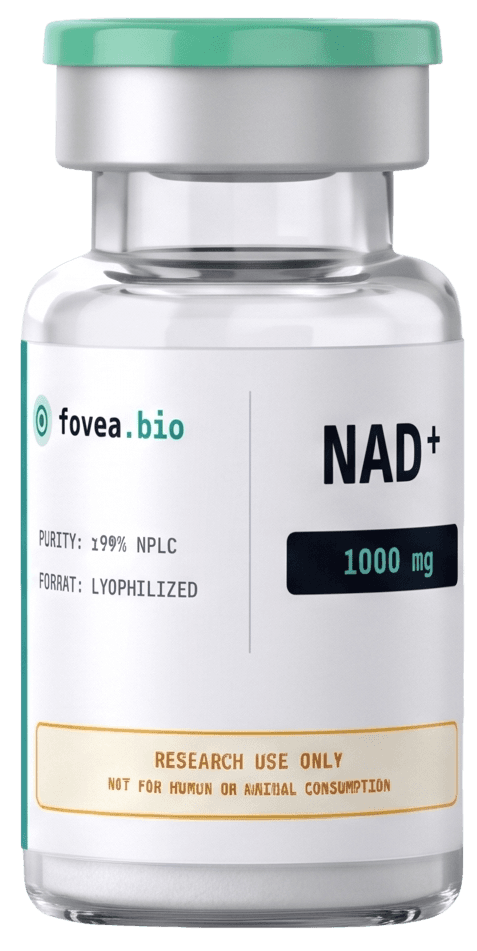
NAD⁺
β-Nicotinamide Adenine Dinucleotide (NAD⁺)
- ≥99% HPLC
- LC-MS Verified
- Tested
- Vacuum-Sealed
- Cold-Chain Ready
The central energy-transfer molecule every cell runs on. Retinal cells burn through enormous amounts, and it is the fuel for the sirtuin repair enzymes. In laboratory assays, it is used to study cellular repair pathways, optimize mitochondrial ATP production, and combat age-related metabolic decline.
Schematic only : not to scale
Relevance to Vision Research
Foveal photoreceptors and retinal ganglion cells are among the most energy-hungry cells in the body, making their NAD⁺ supply a central variable in retinal bioenergetics research.
Where It Acts : Pathway Map
11 structures targetedAn animated map of the visual pathway, from the eye through the brain to the systemic processes of aging. Highlighted nodes mark the structures NAD⁺ is studied against.
Illustrative research map : highlighted structures reflect the published in-vitro / preclinical literature, not human outcomes.
Key Performance Benefits
Scientifically supported advantages for peak performance and recovery.
Redox cofactor in ATP generation
Carries electrons through glycolysis, the TCA cycle, and oxidative phosphorylation. Its oxidised-to-reduced cycling is measured directly in bioenergetic assays.
Sirtuin and PARP substrate
Consumed as a substrate by the sirtuin and PARP enzyme families, which links energy metabolism to protein deacetylation and the DNA-damage response.
Age-associated pool decline
Published measurements document declining tissue NAD⁺ pools with age and metabolic stress across a range of model systems.
Research use only. Not a drug, food, cosmetic, or supplement. Not for human or veterinary use, consumption, or administration by any route. Not evaluated by the FDA. Nothing on this page is intended to diagnose, treat, cure, or prevent any disease, and no human outcome is asserted.
Reported in the literature
2 references ↓Protected retinal ganglion cells[1]
NAD⁺ repletion prevented RGC loss in a landmark aged-mouse glaucoma study.
The cellular fuel cofactor[2]
Essential carrier in the energy chain that retinal cells depend on most.
Powers the repair enzymes[2]
The substrate sirtuins and PARPs consume; tissue levels decline with age.
Sharper energy metabolism[2]
Central to converting nutrients into the ATP that retinal cells consume rapidly.
Summaries of observations reported in published in-vitro and preclinical research. These are research-model findings, not established human outcomes, and not claims of benefit, safety, or efficacy. Supplied for laboratory research use only.
The most reused molecule in metabolism
NAD⁺ is not a peptide and not a drug candidate. It is the pyridine nucleotide that carries electrons through glycolysis, the TCA cycle, and oxidative phosphorylation, cycling between its oxidised and reduced forms thousands of times a day. Almost every energy-yielding reaction in the cell passes through it.
What made it a subject of aging research rather than just a textbook cofactor is a second role. NAD⁺ is not only recycled, it is also consumed as a substrate by two enzyme families: the sirtuins (SIRT1 through SIRT7), which strip acetyl groups from proteins including histones, and the PARPs, which respond to DNA damage. Both eat NAD⁺ to do their work. That puts energy metabolism, gene regulation, and DNA repair in direct competition for the same finite pool.
Tissue NAD⁺ pools decline with age and metabolic stress across a range of published measurements. When DNA damage rises and PARP activity increases, the literature describes sirtuin activity falling as a consequence of substrate scarcity rather than any change in the sirtuins themselves.
Why the retina is the interesting tissue
Retinal ganglion cells are a stark case. Their axons are unmyelinated as they cross the retinal surface, which means every signal costs more energy to propagate than it would in a myelinated nerve. They are also long. The result is a neuron running near its metabolic ceiling as a matter of routine.
Retinal ganglion cell bioenergetics and the NAD⁺ pool that supports it are surveyed in our foveal mitochondrial load note. The literature there covers NAD⁺ dependence, sirtuin and PARP involvement, and reported retinal ganglion cell outcomes following NAD⁺ repletion in optic-neuropathy and glaucoma models. All of it is animal-model and in-vitro work.
What this standard is for
Catalogued as an analytical reference standard for cofactor-dependent enzymology: sirtuin and PARP activity assays, NAD⁺/NADH ratio determination, dehydrogenase kinetics, and as a calibration standard for LC-MS and HPLC quantification of nucleotide pools.
NAD⁺ is hygroscopic and hydrolyses in solution, particularly at alkaline pH, so a characterised standard matters more here than intuition suggests. Freshly prepared solutions and confirmed purity are the difference between a clean standard curve and a slow drift nobody notices.
NAD⁺: common questions
- Is NAD⁺ the same as NMN or NR?
- No. NMN (nicotinamide mononucleotide) and NR (nicotinamide riboside) are biosynthetic precursors that cells convert into NAD⁺ through the salvage pathway. NAD⁺ is the finished dinucleotide cofactor itself. They are distinct molecules with distinct molecular weights and are not interchangeable in an assay.
- What is NAD⁺ used for in the laboratory?
- As a substrate and calibration standard in cofactor-dependent enzymology: sirtuin and PARP activity assays, dehydrogenase kinetics, NAD⁺/NADH ratio measurement, and quantification of nucleotide pools by HPLC or LC-MS.
- Why is NAD⁺ studied in the context of aging?
- Because it is consumed, not merely recycled, by the sirtuin and PARP enzyme families, and because tissue NAD⁺ pools decline with age and metabolic stress in published measurements. That creates competition between energy metabolism, gene regulation, and DNA repair for one finite pool.
- How stable is NAD⁺ in solution?
- Limited. The molecule is hygroscopic as a solid and hydrolyses in aqueous solution, with degradation accelerating at alkaline pH and at room temperature. Prepare solutions fresh, keep them cold and near neutral pH, and avoid repeated freeze-thaw.
- What purity is this standard supplied at?
- ≥99% by HPLC area, with identity confirmed by LC-MS. Supplied as a lyophilized powder in a vacuum-sealed amber vial, stored desiccated at −20 °C.
Why It Is Used
NAD⁺ is a small, highly polar dinucleotide that is fully water-soluble and exceptionally well-characterized, making it a clean analytical reference standard. It is light- and moisture-sensitive in solution, so the lyophilized, amber-sealed format is the appropriate handling state. The in-house conformer ensemble is used mainly to calibrate docking grids against NAD⁺-binding oxidoreductase pockets.
Objective structural / physicochemical opinion. Not medical advice.
Related Scientific Reports
Read the full literature review on NAD⁺Retinal Ganglion Cell Bioenergetics: NAD⁺ Flux and the Foveal Mitochondrial Load
A structured synthesis of the published literature on energy demand in the foveal cone and retinal ganglion cell (RGC) axis, the role of the NAD⁺/NADH redox pair, and reported RGC protection following NAD⁺ repletion in optic-neuropathy and glaucoma models. Presented as a neutral reference survey; no human outcome or product effect is asserted.
Photoreceptor Phototoxicity and Antioxidant Peptide Strategies: A Structural Survey
A structural survey of high-energy-visible (HEV) photo-oxidative stress pathways in photoreceptor and RGC mitochondria, mapped against the reported antioxidant and membrane-stabilizing properties of the catalogued short peptides. Combines a literature map with in-house physicochemical descriptors. Reference survey only.
Documented References
- [1]
Williams PA, et al. (2017) Vitamin B3 modulates mitochondrial vulnerability and prevents glaucoma in aged mice.
Science
View on PubMed - [2]
References point to published, third-party scientific literature, provided for research context. Citation of a study is not an endorsement of any use of this material.
Molecular Identity
- CAS Number
- 53-84-9
- Molecular Formula
- C₂₁H₂₇N₇O₁₄P₂
- Molecular Weight
- 663.43 g/mol
- Purity
- ≥ 99.0% (HPLC, area)
- Format
- Lyophilized powder, vacuum-sealed amber vial
Analytical Specification
Research Context
NAD⁺ is the central pyridine-nucleotide redox cofactor mediating electron transfer in glycolysis, the TCA cycle, and oxidative phosphorylation, and is a consumed substrate of the sirtuin (SIRT1–7) and PARP enzyme families. The published literature documents a decline in tissue NAD⁺ pools with age and metabolic stress. Catalogued here as an analytical reference standard for cofactor-dependent enzyme assays.
Reference conformer ensemble generated locally (RDKit ETKDGv3 + MMFF94s) for docking-grid calibration against NAD⁺-binding oxidoreductase pockets.
Laboratory Handling
Soluble in laboratory-grade water and standard aqueous buffers. Solubility and stability data provided for in-vitro assay design only.