Pinealon
Pinealon (Glu-Asp-Arg, EDR)
- ≥99% HPLC
- LC-MS Verified
- Tested
- Vacuum-Sealed
- Cold-Chain Ready
A three-amino-acid peptide studied for protecting neurons from oxidative damage and apoptosis, relevant to the retinal ganglion cells that are themselves central nervous system neurons. In laboratory research, it is primarily used to investigate cognitive protection, accelerate neurorecovery, and reduce cellular stress under hypoxic conditions.
3 residues · teal = non-canonical / D-isomer · descriptive schematic
Relevance to Vision Research
Retinal ganglion cells are central nervous system neurons with long, metabolically demanding axons. Neuroprotective peptides that reduce oxidative stress and suppress apoptosis are studied in the context of RGC survival and optic-nerve integrity.
Where It Acts : Pathway Map
4 structures targetedAn animated map of the visual pathway, from the eye through the brain to the systemic processes of aging. Highlighted nodes mark the structures Pinealon is studied against.
Illustrative research map : highlighted structures reflect the published in-vitro / preclinical literature, not human outcomes.
Key Performance Benefits
Scientifically supported advantages for peak performance and recovery.
Oxidative stress in neural models
In-vitro studies in cultured neural tissue report reduced reactive oxygen species under induced oxidative stress.
Apoptosis pathway modulation
Animal-model work reports modulation of caspase-3 activity and reduced neuronal apoptosis in stressed neural preparations.
Dendritic spine observations
The Khavinson literature reports restoration of dendritic spine density in neural models. Replication outside that group is limited.
Research use only. Not a drug, food, cosmetic, or supplement. Not for human or veterinary use, consumption, or administration by any route. Not evaluated by the FDA. Nothing on this page is intended to diagnose, treat, cure, or prevent any disease, and no human outcome is asserted.
Reported in the literature
2 references ↓Neuronal oxidative-stress protection[1]
Reported to reduce reactive oxygen species accumulation and support neuronal cell viability under oxidative stress in preclinical models.
Anti-apoptotic in neural tissue[1]
Studied for modulating caspase-3 expression and reducing neuronal apoptosis intensity in hypoxic and neurodegenerative models.
RGC neuroprotection relevance[2]
Retinal ganglion cells are CNS neurons; neuroprotective peptides are studied in the context of RGC survival under metabolic stress (direct ocular data limited).
Dendritic spine restoration[1]
Observed to restore the morphology of dendritic spines in neurodegenerative animal models, supporting synaptic connectivity.
Gene expression regulation[1]
Investigated for its ability to penetrate nuclear membranes and modulate gene expression and protein synthesis in neurons.
Cognitive aging research[2]
Studied in elderly patient cohorts and TBI models for effects on memory, attention, and overall cognitive performance.
Geroprotective bioregulator[2]
Classified as a peptide bioregulator in the Khavinson gerontological framework, investigated for slowing age-related neuronal decline.
Summaries of observations reported in published in-vitro and preclinical research. These are research-model findings, not established human outcomes, and not claims of benefit, safety, or efficacy. Supplied for laboratory research use only.
Three residues from a cortical extract
Pinealon is a tripeptide, Glu-Asp-Arg, drawn from the same Russian bioregulation tradition as Epitalon. Where Epitalon traces to a pineal preparation, EDR was identified as an active sequence within Cortexin, a polypeptide complex isolated from cerebral cortex.
Three residues is about as short as a peptide gets while still being a peptide, and the same caution applies here as to the rest of this literature: the proposed mechanism involves direct interaction with DNA regulatory regions, most of the work comes from one research tradition, and independent replication outside that tradition is limited. We think the structural chemistry is interesting and the evidence base is narrow, and both of those things can be true at once.
Why a neuroprotection peptide sits in a vision catalogue
Because retinal ganglion cells are central nervous system neurons. They are not a special ocular cell type that happens to live in the eye: they are projection neurons whose axons form the optic nerve and terminate in the brain, and they behave like CNS neurons in how they respond to oxidative stress and how they die.
That is why apoptosis research is relevant to the retina at all. The published EDR literature reports reduced reactive oxygen species, caspase-3 modulation, and dendritic spine restoration in in-vitro and animal models of neural tissue, which is the same machinery implicated in retinal ganglion cell loss in glaucoma and optic neuropathy models. Our survey of that work is in the neuroprotection note, and the docking study against neuronal DNA regulatory domains is here.
The connection is mechanistic and indirect. No published work establishes an outcome in human vision, and this page does not suggest one.
What this vial is for
Catalogued as a sequence-defined peptide reference standard for neuroprotection and oxidative-stress assays: ROS quantification in cultured neurons, caspase activity assays, apoptosis panels, and nucleic-acid interaction or docking work requiring a characterised EDR standard.
Identity is confirmed by LC-MS and purity by HPLC to a ≥99% specification. As with the other short, highly charged sequences here, that confirmation is worth having rather than assuming.
Pinealon: common questions
- What is Pinealon?
- Pinealon is a synthetic tripeptide with the sequence Glu-Asp-Arg (EDR). It was identified as an active sequence within Cortexin, a polypeptide complex isolated from cerebral cortex, and is used in research as a characterised standard for neuroprotection and oxidative-stress assays.
- How does Pinealon relate to Cortexin?
- Cortexin is a complex mixture of polypeptides extracted from cerebral cortex. Pinealon is a single defined tripeptide proposed as one of its active sequences. A defined synthetic tripeptide and a tissue extract are very different research materials.
- What does the neuroprotection literature report?
- Published in-vitro and animal-model work, primarily from the Khavinson bioregulation group, reports reduced reactive oxygen species, modulation of caspase-3 activity, and restoration of dendritic spines in neural tissue. These are research-model findings, and independent replication outside that research tradition is limited.
- Why is a neuroprotective peptide relevant to vision research?
- Because retinal ganglion cells are central nervous system neurons whose axons form the optic nerve. They respond to oxidative stress and undergo apoptosis through the same machinery as other CNS neurons, so neuroprotection research in neural tissue is mechanistically relevant to models of retinal ganglion cell loss.
- How is the Pinealon reference standard supplied and stored?
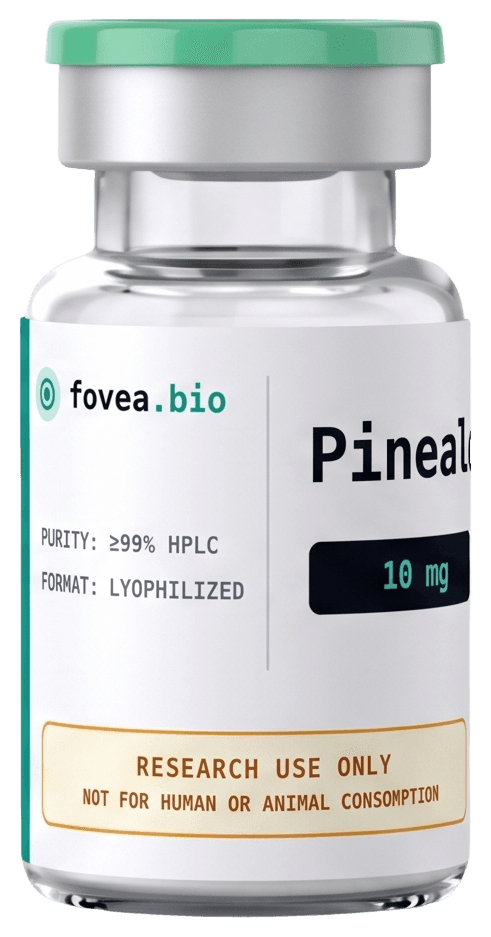
- As a lyophilized powder in a vacuum-sealed amber vial. Store at −20 °C, desiccated, and avoid repeated freeze-thaw of reconstituted aliquots. Purity is ≥99% by HPLC with identity confirmed by LC-MS.
Why It Is Used
EDR is the smallest peptide in the catalogue: a compact tripeptide with two acidic residues (Glu, Asp) and one basic (Arg), giving it a net negative charge at physiological pH and high water solubility. Its small molecular mass (418 Da) makes identity confirmation by LC-MS straightforward, with the [M+H]⁺ ion at m/z 419.2 as the primary diagnostic peak. The tripeptide's size is consistent with the DNA minor-groove contacts proposed in the Khavinson bioregulation literature.
Objective structural / physicochemical opinion. Not medical advice.
Related Scientific Reports
Read the full literature review on PinealonEDR Peptide (Pinealon) in Neuroprotection: Oxidative Stress Reduction and Anti-Apoptotic Mechanisms in Neural Tissue
A structured review of the published Khavinson bioregulation literature on the tripeptide EDR (Pinealon), focusing on its reported neuroprotective mechanisms: reactive oxygen species suppression, caspase-3 modulation, and dendritic spine morphology restoration in preclinical models of hypoxia and neurodegeneration. RGC relevance is contextualized as a CNS-neuron neuroprotection target. Reference survey only; no clinical outcome is asserted.
Flexible Docking of EDR Tripeptide against Neuronal DNA Regulatory Domains
An all-atom flexible-docking study of the tripeptide EDR (Pinealon) against model neuronal gene regulatory DNA sequences. Conformer ensembles were generated and ranked by interface contact density and predicted binding affinity. The compact tripeptide geometry is consistent with minor-groove contacts. Reported as structural reference data; no transcriptional outcome is asserted.
Documented References
- [1]
Khavinson VK, Linkova NS, et al. (2021) Short Peptides Stimulate Serotonin Expression in Cells of Brain Cortex.
Bulletin of Experimental Biology and Medicine
View on PubMed - [2]
Khavinson VK, Grigoriev EI, et al. (2014) Tripeptide EDR (Pinealon): Neuroprotective Effects in Models of Hypoxia and Neurodegeneration.
Advances in Gerontology
View on PubMed
References point to published, third-party scientific literature, provided for research context. Citation of a study is not an endorsement of any use of this material.
Molecular Identity
- CAS Number
- 175175-23-2
- Molecular Formula
- C₁₅H₂₆N₆O₈
- Molecular Weight
- 418.41 g/mol
- Sequence
- H-Glu-Asp-Arg-OH (EDR)
- Purity
- ≥ 99.0% (HPLC, area)
- Format
- Lyophilized powder, vacuum-sealed vial
Analytical Specification
Research Context
Pinealon (EDR) is a synthetic tripeptide derived from the active sequence of Cortexin, a polypeptide complex isolated from the cerebral cortex. The published literature (primarily from the Khavinson bioregulation group) reports in-vitro and animal-model studies of its proposed neuroprotective mechanisms, including ROS reduction, caspase-3 modulation, and dendritic spine restoration. Catalogued here as a sequence-defined peptide reference standard for neuronal viability and oxidative-stress assays.
Laboratory Handling
Soluble in laboratory-grade water. Solubility and stability data provided for in-vitro handling only.