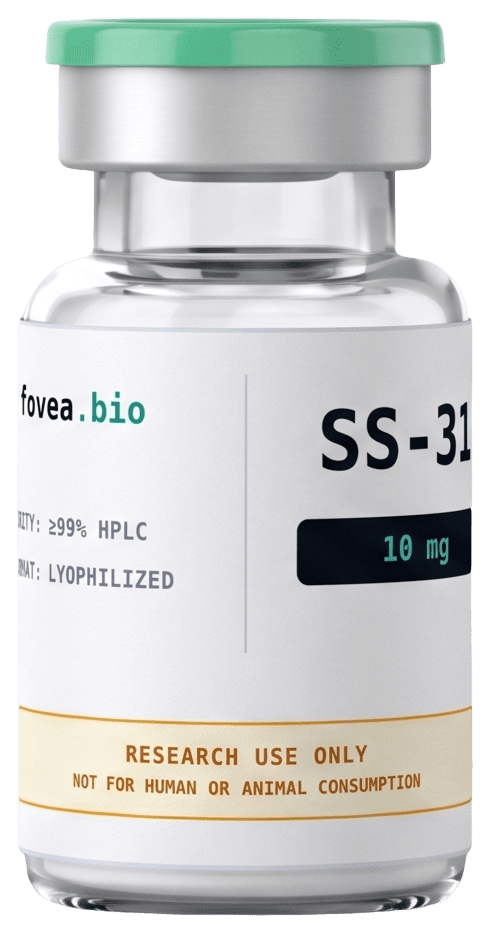
SS-31
SS-31 / Elamipretide (D-Arg-Dmt-Lys-Phe-NH₂)
- ≥99% HPLC
- LC-MS Verified
- Tested
- Vacuum-Sealed
- Cold-Chain Ready
A small peptide that targets cardiolipin, the key lipid inside mitochondria, the energy plants that retinal cells rely on more than almost any other tissue. In laboratory research, it is primarily used to investigate mitochondrial recovery, prevent cellular oxidative stress, and support retinal ganglion cell survival.
4 residues · teal = non-canonical / D-isomer · descriptive schematic
Relevance to Vision Research
Retinal ganglion cells and foveal photoreceptors carry one of the highest mitochondrial densities in the human body. SS-31 is studied in vision research precisely because it concentrates at mitochondrial cardiolipin.
Where It Acts : Pathway Map
10 structures targetedAn animated map of the visual pathway, from the eye through the brain to the systemic processes of aging. Highlighted nodes mark the structures SS-31 is studied against.
Illustrative research map : highlighted structures reflect the published in-vitro / preclinical literature, not human outcomes.
Key Performance Benefits
Scientifically supported advantages for peak performance and recovery.
Cardiolipin association
Published in-vitro work describes association with cardiolipin in the inner mitochondrial membrane, with reported effects on cristae organisation and the arrangement of electron-transport-chain complexes.
Retinal ganglion cell models
Preclinical retinal and optic-neuropathy models report reduced retinal ganglion cell loss under induced stress. These are animal-model and cell-culture observations.
Oxidative stress markers
Studies report reduced reactive oxygen species production and better-maintained mitochondrial membrane potential in metabolically stressed preparations.
Research use only. Not a drug, food, cosmetic, or supplement. Not for human or veterinary use, consumption, or administration by any route. Not evaluated by the FDA. Nothing on this page is intended to diagnose, treat, cure, or prevent any disease, and no human outcome is asserted.
Reported in the literature
2 references ↓Studied in macular degeneration[1]
Evaluated in clinical research programmes for dry AMD and geographic atrophy.
Supports retinal cell energy[2]
Reported to protect RGC and photoreceptor mitochondria under stress in preclinical models.
Targets cardiolipin[2]
Binds the inner-membrane lipid cardiolipin and helps stabilize energy production.
Lowers oxidative stress[2]
Studied for reducing reactive-oxygen-species (ROS) leakage from the energy chain.
Counters mitochondrial aging[2]
Investigated for age-related decline in mitochondrial efficiency across tissues.
Summaries of observations reported in published in-vitro and preclinical research. These are research-model findings, not established human outcomes, and not claims of benefit, safety, or efficacy. Supplied for laboratory research use only.
The problem SS-31 was designed around
Mitochondria do not generate energy across a flat surface. The inner membrane folds into dense pleats called cristae, and the folding is what makes the chemistry work: it packs an enormous amount of respiratory machinery into a small volume and holds the electron-transport complexes close enough together to hand electrons along efficiently.
Holding that geometry is the job of cardiolipin, an unusual four-tailed phospholipid found almost nowhere else in the cell. Cardiolipin is also chemically fragile. Its tails are polyunsaturated, it sits directly beside the respiratory chain where reactive oxygen species are produced, and when it oxidises the cristae lose their shape. The literature describes a self-reinforcing loop: oxidised cardiolipin means looser cristae, looser cristae mean less efficient electron transfer, and less efficient transfer means more leakage.
SS-31 is an aromatic-cationic tetrapeptide designed to concentrate at that membrane. Its alternating charged and aromatic residues, including a non-standard 2,6-dimethyltyrosine, let it associate with cardiolipin without collapsing the membrane potential the way most cationic molecules would.
Why vision researchers keep returning to it
The retina is an unusually demanding place to be a mitochondrion. Photoreceptor inner segments and retinal ganglion cell axons carry some of the highest mitochondrial densities in the body, and the retina combines that load with intense light exposure, high oxygen tension, and membranes rich in exactly the polyunsaturated fats that oxidise first.
That combination is why elamipretide has been investigated in retinal contexts, including study programmes in dry age-related macular degeneration and geographic atrophy, and in preclinical diabetic retinopathy models. Our own literature synthesis on this sits in the science notes, and the structural work on how the peptide sits against the cardiolipin interface is written up separately.
None of that work establishes a human outcome, and the clinical programmes are the property of the sponsors who ran them. What it does explain is why this particular tetrapeptide shows up so often in retinal bioenergetics assays.
What this vial is for
Catalogued as a sequence-defined peptide reference standard for mitochondrial and phospholipid interaction work: membrane association assays, cardiolipin binding studies, cristae morphology imaging, and respiratory-chain assays in cultured cells and isolated mitochondria.
Identity is confirmed by LC-MS and purity by HPLC against a ≥99% specification. The non-canonical Dmt residue makes identity confirmation worth doing rather than assuming, since it is the residue most likely to be substituted in poorly made material.
SS-31: common questions
- Is SS-31 the same as elamipretide?
- Yes. SS-31 is the original research designation and elamipretide is the international nonproprietary name for the same tetrapeptide. You will also see it referred to as MTP-131 and Bendavia in older literature. All four names describe D-Arg-Dmt-Lys-Phe-NH₂.
- What does SS-31 actually bind to?
- Cardiolipin, a four-tailed phospholipid concentrated in the inner mitochondrial membrane. The published mechanism describes association with cardiolipin rather than binding to a conventional protein receptor, which is why the peptide localises to mitochondria without requiring a transporter.
- Why does SS-31 appear so often in retinal research?
- Because retinal tissue is where mitochondrial stress is most concentrated. Photoreceptors and retinal ganglion cells carry very high mitochondrial densities and sit in an environment of intense light and high oxygen, so retinal models are a natural test bed for compounds studied at the inner mitochondrial membrane.
- What is the 2,6-dimethyltyrosine residue for?
- Dmt is a non-canonical aromatic residue that contributes to the alternating aromatic-cationic motif the peptide depends on for membrane association. It also makes analytical confirmation worthwhile, since it is the residue most likely to differ in substandard material.
- How is the SS-31 reference standard supplied and stored?
- As a lyophilized powder in a vacuum-sealed amber vial. Store at −20 °C, desiccated and protected from light, and avoid repeated freeze-thaw cycles of reconstituted aliquots. Identity is confirmed by LC-MS and purity by HPLC to a ≥99% specification.
Why It Is Used
The alternating aromatic-cationic motif (D-Arg / Dmt / Lys / Phe) gives SS-31 a concentrated positive charge paired with two aromatic faces, a geometry consistent with the electrostatic and stacking contacts observed against anionic cardiolipin head-groups in the in-house bilayer modeling. The D-arginine and amidated C-terminus are notable for peptidase resistance. It is highly water-soluble and well-behaved; the Dmt residue is the key identity marker, verified by MS/MS.
Objective structural / physicochemical opinion. Not medical advice.
Related Scientific Reports
Read the full literature review on SS-31Elamipretide (SS-31) in Retinal Mitochondrial Protection: A Literature Synthesis
A survey of published preclinical and clinical research on the aromatic-cationic tetrapeptide SS-31 (elamipretide) in retinal contexts, including the ReCLAIM programme of AMD and geographic-atrophy clinical trials and preclinical models of traumatic optic neuropathy. Mechanistic emphasis is placed on cardiolipin association and inner-membrane stabilization. Reference survey only; efficacy is not asserted.
Dynamic Association of SS-31 with Cardiolipin and the PLSCR3 Interface in a Model Inner-Membrane Bilayer
A membrane-embedded interaction study modeling the aromatic-cationic tetrapeptide SS-31 against cardiolipin and a PLSCR3 interface model. Association trajectories were sampled and characterized by electrostatic contact persistence and aromatic stacking occupancy. Reported as structural reference data; no physiological effect is asserted.
Photoreceptor Phototoxicity and Antioxidant Peptide Strategies: A Structural Survey
A structural survey of high-energy-visible (HEV) photo-oxidative stress pathways in photoreceptor and RGC mitochondria, mapped against the reported antioxidant and membrane-stabilizing properties of the catalogued short peptides. Combines a literature map with in-house physicochemical descriptors. Reference survey only.
Documented References
- [1]
Mettu PS, Allingham MJ, Cousins SW. (2022) Phase 1 Clinical Trial of Elamipretide in Dry Age-Related Macular Degeneration and Noncentral Geographic Atrophy: ReCLAIM NCGA Study.
Ophthalmology Science
View on PubMed - [2]
Szeto HH. (2014) First-in-class cardiolipin-protective compound as a therapeutic agent to restore mitochondrial bioenergetics.
British Journal of Pharmacology
View on PubMed
References point to published, third-party scientific literature, provided for research context. Citation of a study is not an endorsement of any use of this material.
Molecular Identity
- CAS Number
- 736992-21-5
- Molecular Formula
- C₃₂H₄₉N₉O₅
- Molecular Weight
- 639.79 g/mol
- Sequence
- H-D-Arg-Dmt-Lys-Phe-NH₂ (Dmt = 2,6-dimethyltyrosine)
- Purity
- ≥ 99.0% (HPLC, area)
- Format
- Lyophilized powder, vacuum-sealed vial
Analytical Specification
Research Context
SS-31 (elamipretide) is an aromatic-cationic tetrapeptide widely studied for its association with cardiolipin in the inner mitochondrial membrane and its reported effects on electron-transport-chain organization in in-vitro and preclinical models. It incorporates a non-canonical 2,6-dimethyltyrosine (Dmt) residue. Catalogued here as a peptide reference standard for mitochondrial and phospholipid interaction assays.
Active in-silico track: dynamic association modeling of SS-31 with cardiolipin and the PLSCR3 interface in a model inner-membrane bilayer. Interaction trajectories published, anonymized, as structural reference data only.
Laboratory Handling
Soluble in laboratory-grade water. Solubility and stability data provided for in-vitro membrane assay design only.